Lunar Impact by Hall R. Cargill; Dickson Paul;
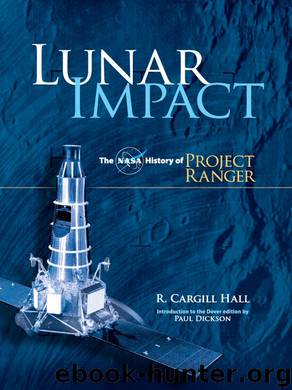
Author:Hall, R. Cargill; Dickson, Paul;
Language: eng
Format: epub
ISBN: 1894344
Publisher: Dover Publications
Published: 2012-10-11T04:00:00+00:00
A few days later, in choosing the nonvisual secondary experiments for the Ranger Block IV spacecraft, NASA’s Space Science Committee passed over sky scientists in favor of their planetary colleagues. The Committee selected James Arnold’s gamma-ray spectrometer and Walter Brown’s pulse radar as the scientific passengers to complement the RCA television cameras. In making known their choice to Homer Newell, however, Committee members expressed misgivings over “the subordinate role in which the non-visual experiments have been placed” in the “objectives established for these flights” by the Office of Space Sciences.32
As though responding to these misgivings, Newell observed a few days later before the American Society of Newspaper Editors that opinion was divided over the merits and motives of NASA’s space science program. The program was now viewed variously as advancing knowledge, sowing the seeds for future applications, or supporting either the manned flight program or military efforts. Newell, consistently in character, asserted: “Such discussions [imply] that the science program would be different if the motivation was different. However, it is our conviction that the kind of research that best supports any of these objectives is a good, sound, scientific program.”33
On April 25 Newell added to the fretful Ranger experimenter Harold Urey that it was too soon to tell conclusively whether pictures of the moon’s surface would prove of greater scientific value than nonvisual experiments. “We have asked the Space Science Board [of the National Academy of Sciences] a number of times for its recommendation in this area, and each time the answer has been that first priority should go to obtaining pictures.” Undoubtedly, there would be “many questions about the lunar surface that will not be answered by the taking of pictures, and that, indeed, in the long run will be more important scientifically than the early pictures are likely to be. These measurements,” Newell pledged, “will most certainly be made in the course of the [Ranger] program, and they will be made just as soon as we have the opportunity to do so.”
Newell also explained to the Ranger scientists that they were to be given greater opportunity at JPL to influence the design and use of their experiments. That included Arnold and Brown on the nonvisual gamma-ray experiment and the radar surface properties experiment, as well as the experimenter team associated with the television cameras on Ranger Block IV. “In this block of Rangers, then, we will be placing greater emphasis on scientific measurements, and it is our understanding that the experiments selected are those that you and our other advisors would like to see done.”34
The next day Newell notified JPL Director Pickering of the additional experiments selected by the Office of Space Sciences for Ranger Block IV, and of his desire to see that these instruments not be subordinated to television photography in the conduct of the missions. “While I concur in the importance of the television system,” he said, “it should be recognized that we have not de-emphasized the importance of obtaining scientific measurements which can be provided by non-visual experiments.
Download
This site does not store any files on its server. We only index and link to content provided by other sites. Please contact the content providers to delete copyright contents if any and email us, we'll remove relevant links or contents immediately.
Whiskies Galore by Ian Buxton(42154)
Introduction to Aircraft Design (Cambridge Aerospace Series) by John P. Fielding(33244)
Small Unmanned Fixed-wing Aircraft Design by Andrew J. Keane Andras Sobester James P. Scanlan & András Sóbester & James P. Scanlan(32872)
Aircraft Design of WWII: A Sketchbook by Lockheed Aircraft Corporation(32382)
Craft Beer for the Homebrewer by Michael Agnew(18342)
Turbulence by E. J. Noyes(8201)
The Complete Stick Figure Physics Tutorials by Allen Sarah(7476)
The Institute by Stephen King(7151)
The Thirst by Nesbo Jo(7093)
Kaplan MCAT General Chemistry Review by Kaplan(7051)
Bad Blood by John Carreyrou(6727)
Modelling of Convective Heat and Mass Transfer in Rotating Flows by Igor V. Shevchuk(6532)
Weapons of Math Destruction by Cathy O'Neil(6465)
Learning SQL by Alan Beaulieu(6400)
Man-made Catastrophes and Risk Information Concealment by Dmitry Chernov & Didier Sornette(6217)
Permanent Record by Edward Snowden(5950)
Digital Minimalism by Cal Newport;(5919)
Life 3.0: Being Human in the Age of Artificial Intelligence by Tegmark Max(5685)
iGen by Jean M. Twenge(5506)
